Mantegna
A Birthday Blog

Today, I celebrate both my birthday and the ten-year anniversary of my first move to New York. Some things haven’t changed: my social and professional ecosystems are once again nestled between 60th and 72nd on the West Side; the Joe Coffee on Columbus and 69th is where I’m attempting yet again to get a blog up and running (by writing about things only tangentially related to music, as usual); and I’m back in school, this time commencing a PhD program at Columbia University (a fate which everyone saw coming but me).
The changes are lamentable. I have less hair in certain places and more in others than a decade ago. A decrease in both alcohol and capsaicin tolerance transforms evenings at Somtum Der or the Eagle into matters of delicate planning (and indeed, of choice, as one no longer visits both establishments in the same evening). Words like “sciatica” and “plantar fasciitis” are more frequent in conversation. I’m no longer on a first-name basis with the baristas, one of whom is discussing at length with a customer about the color of her aura, the flavor of her chi, and how her third eye “isn’t coping these days.” She’s a Pisces and emotional, so we ought to forgive her. (Apparently.) What I can’t forgive is myself for having left my noise-cancelling headphones at home.
Pinacoteca di Brera / Musée Condé
Instagram is more present in my life, and if anything has become a useful documentation tool from my travels. For weeks, I’ve been meaning to write about a few wonderful days I spent in Milan, and looking back at the photos from various museums has jogged my memory sufficiently. Mantegna’s Lamentation of Christ has been written about ad nauseam. Sure, Christ is super-dead, the viewpoint is odd, there is nothing too terribly subtle, and yes, just maybe, that’s what makes it arresting to look at.
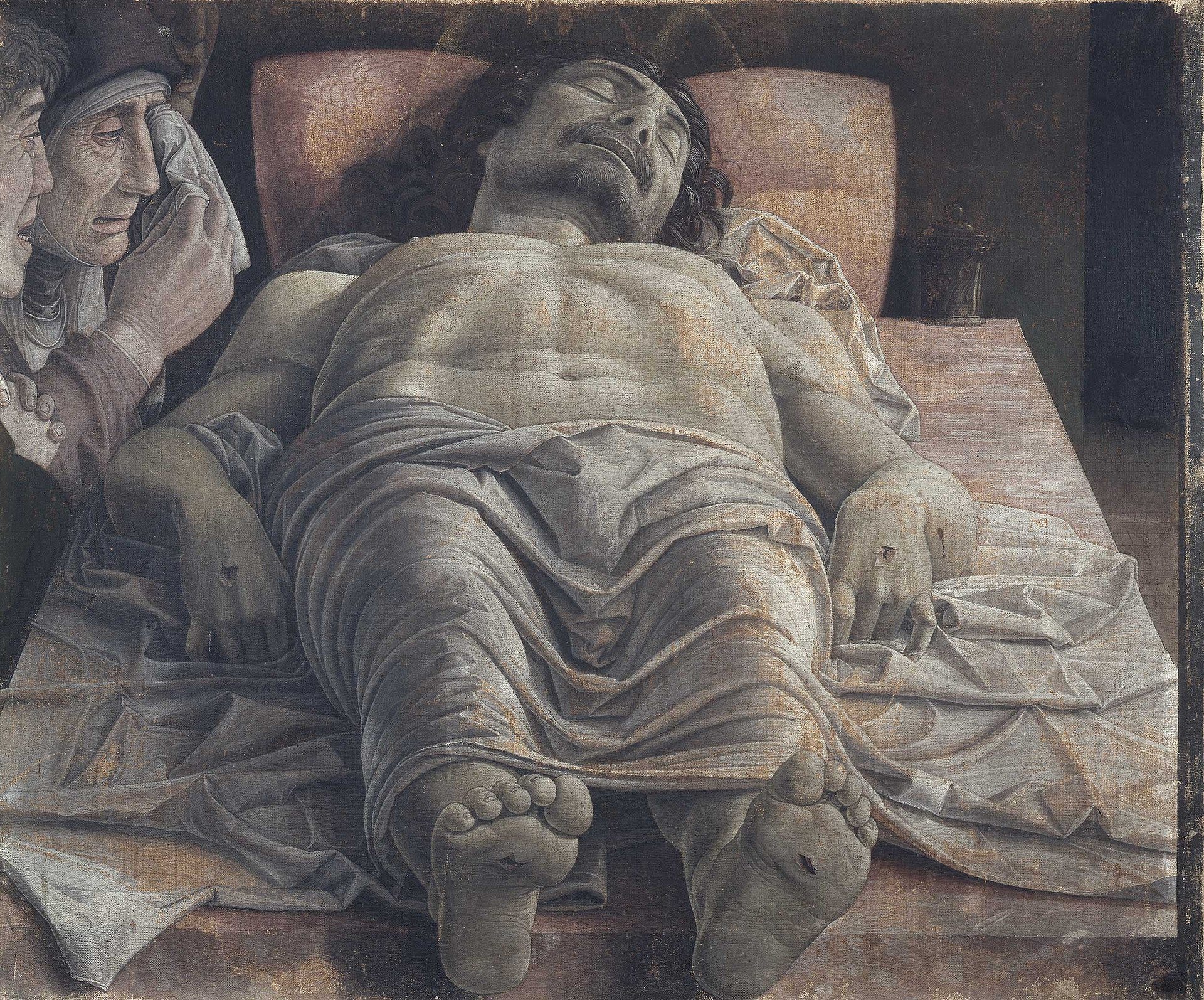
And yet, the painting hit me harder this time. For weeks after I’d been trying to figure out why, and I honestly think it was because I had spent three days basking in images of naked and holy human bodies. Throughout the Brera and other museums, there are countless paintings which draw attention to or sexualize one or another facet of Christ’s body. The infant Christ is often naked, with his genitals at the very center of the photo.
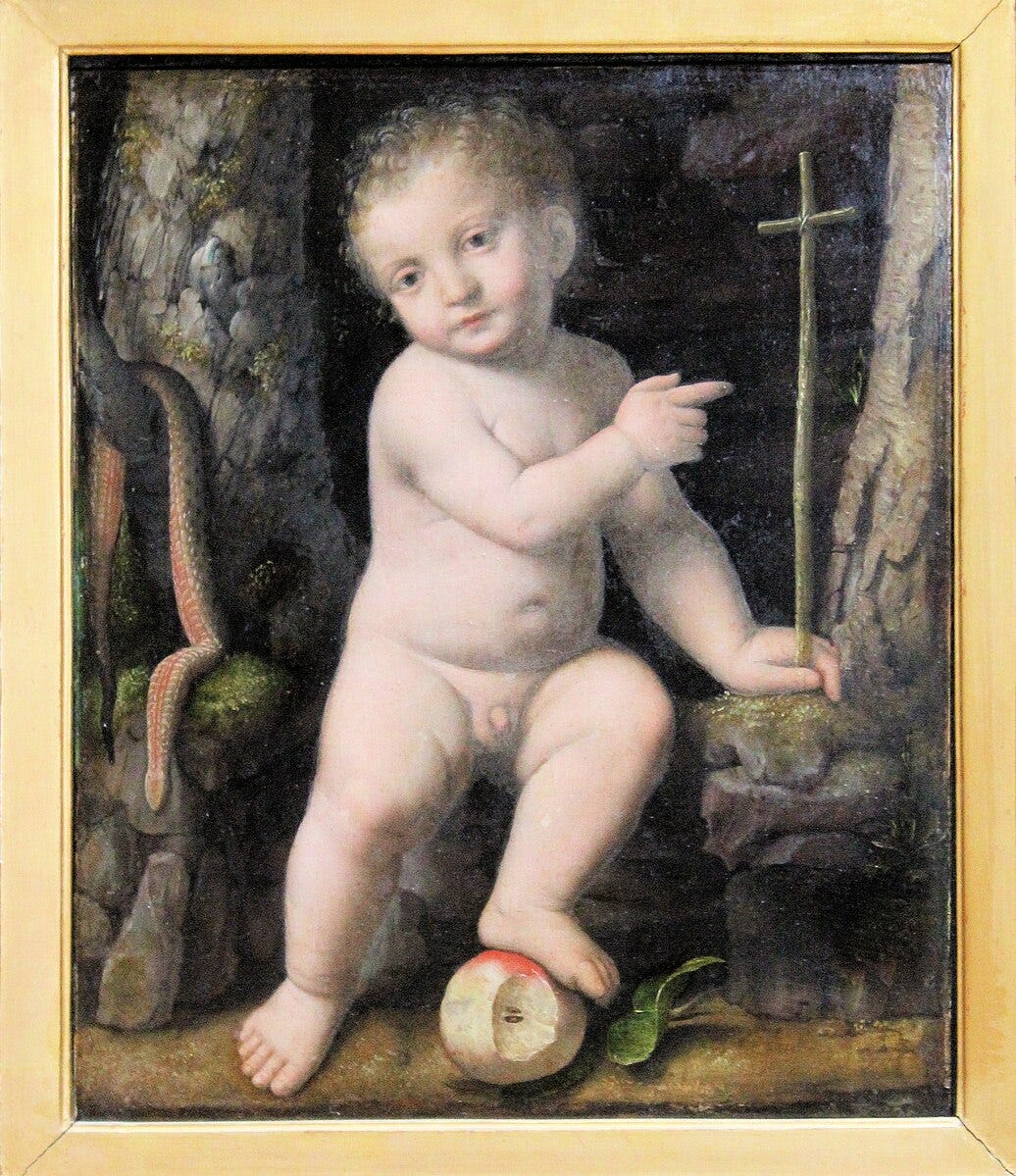
On occasion, you see intentional aberrations. At the Musée Condé, Luini’s Infant Jesus literally tells you to look away. The snake is dead, and the naked Christ’s foot rests on a fresh apple with a bite taken out of it. One looks at the center, but the exposed Child looks back, pointing to a small cross, as if to say, “I’ve given you what you want, now take what you need.”
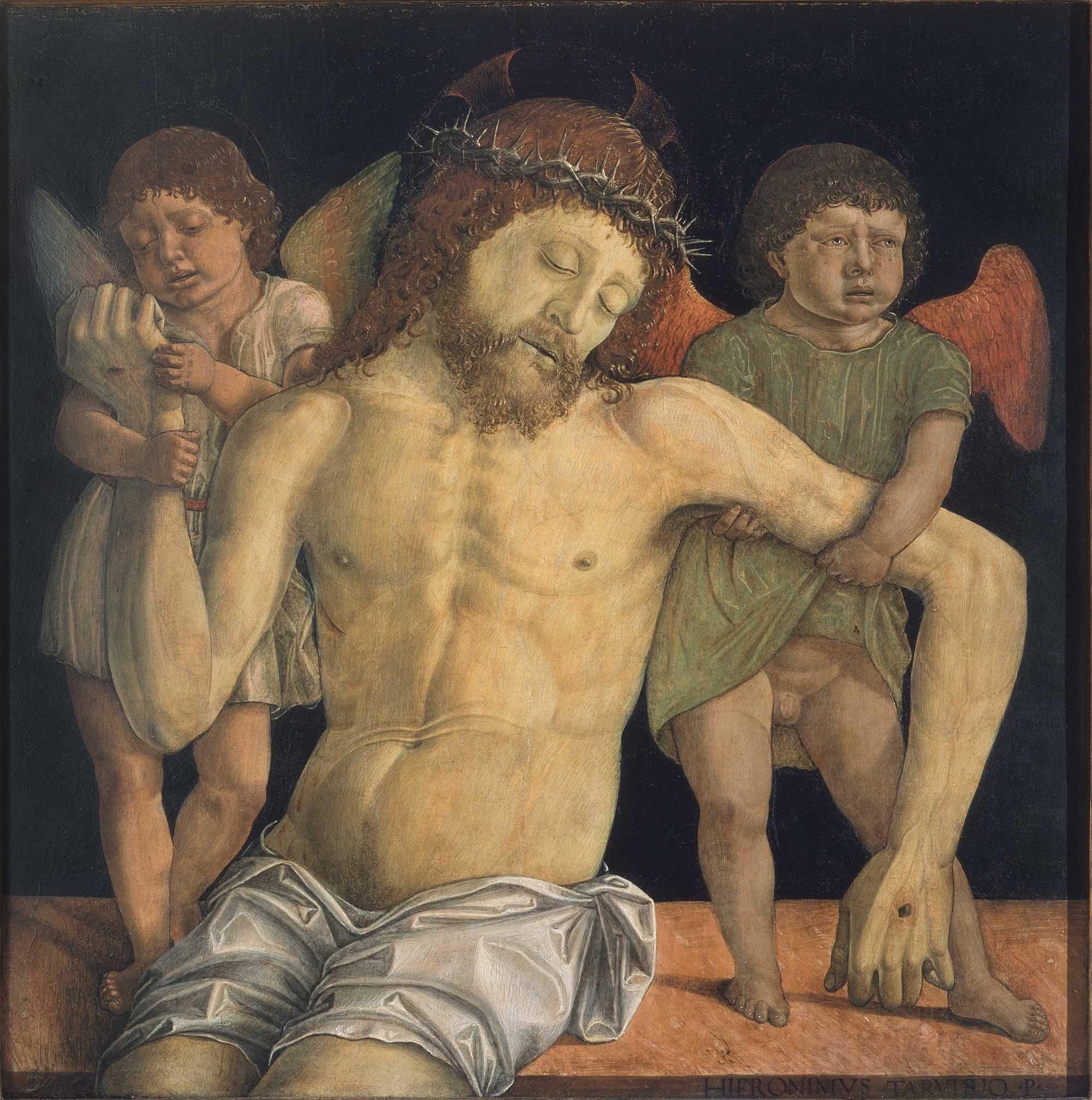
Meanwhile, the normative adult Christ has abs, nice pecs, and a habit of bearing a supplicating or even seductive pose as he dies. The modesty shroud covers the genitals, but the legs are exposed, beneath a torso that bears down upon the hips, which have seemingly collapsed. Treviso’s Christ Supported by Two Angels is astonishing as one of the weeping infant angels lifts his tunic to expose his genitals, as if to say, “Isn’t it enough? How could you possibly want more?”
Mantegna subverts the tropes by way of omission. There is no modesty shroud, but instead an actual funerary cloth. You can tell there are legs beneath, but the wrinkles in the cloth conceal any detail. You can tell the body is toned and defined, but somehow, exsanguination seems to be the culprit more than some calisthenic routine. Christ’s crotch is at the center, and yet there is nothing exaggerated or erotic about it. All the essential elements are there: the exquisite corpse, the stigmata, the mourners - but there’s no sense that it has been done for any reason. What makes the depiction so stark is the absence of those theological symbols that render violence redemptive. No apple, no angels, no Garden of Eden. There is no outright reference to salvation, there is no presence of youth or reference to renewal, no depiction of the sky or landscape. There is no hint that something will come of it, nor is there any hint of guilt or culpability. It’s Godless.
Museo Poldi Pezzoli / Musée Jacquemart André
I must say that the eyes start to glaze over at European museums. The embarrassment of riches is such that symbols and tropes fade into each other. At the Pinacoteca Ambrosiana (my first stop in Milan), I wondered how many Leonardo-Luini adjacent dudes that look like women I would have to endure; how many ecstatic Saint Sebastians it would take for the metaphors of sodomy not to seem anything but pedestrian; or how many organs Saint Cecilia played before she died of boredom at the sauna.
But of course, this is the point. A good museum is a bit like life, in that much of it will bore you (though it might tickle someone else’s fancy). When something truly is different, it pops out. There’s nothing quite like walking into the final room at the Ambrosiana to see Leonardo’s notes and sketches to realize “Holy shit. They are all written backwards.”
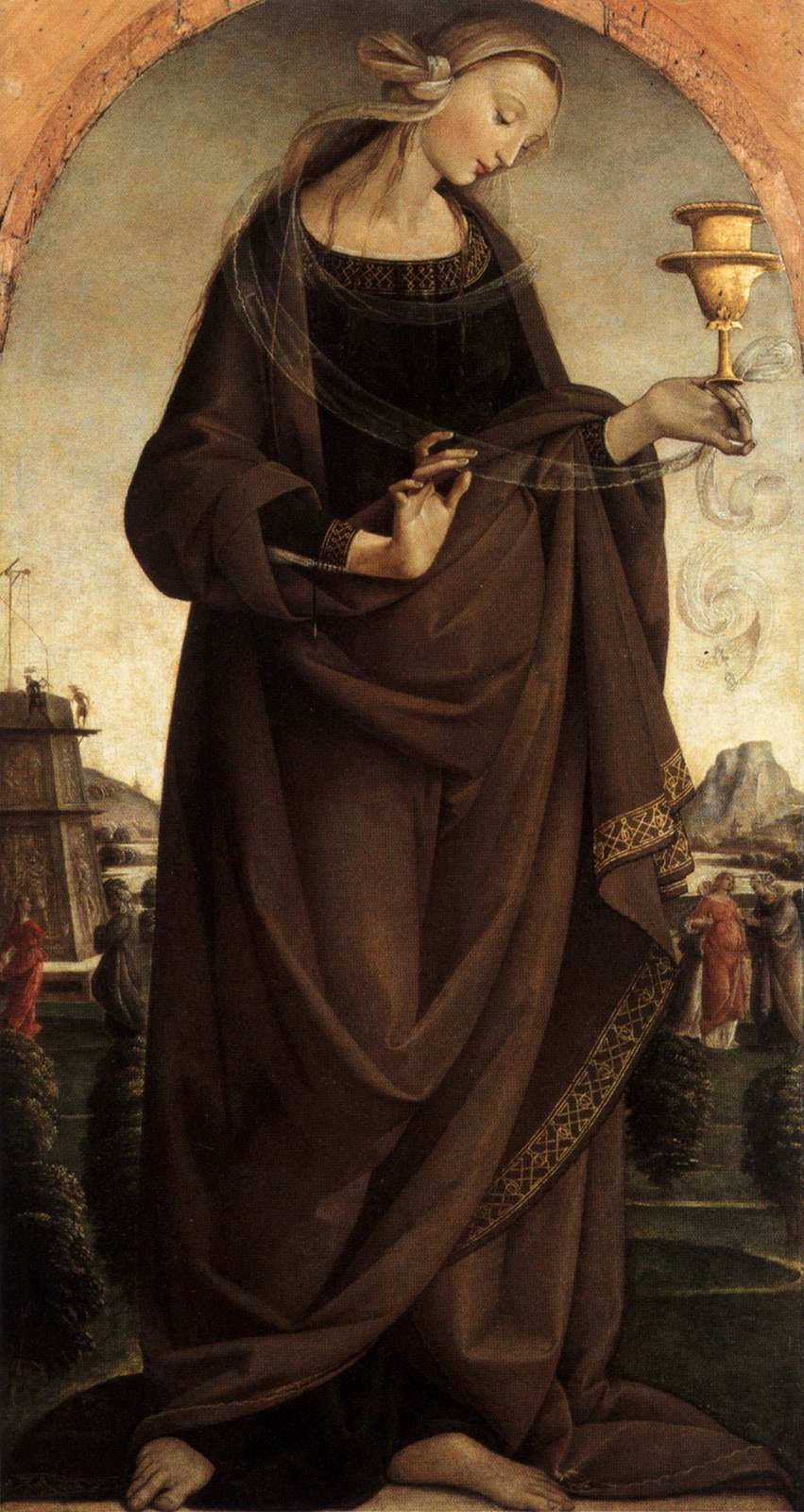
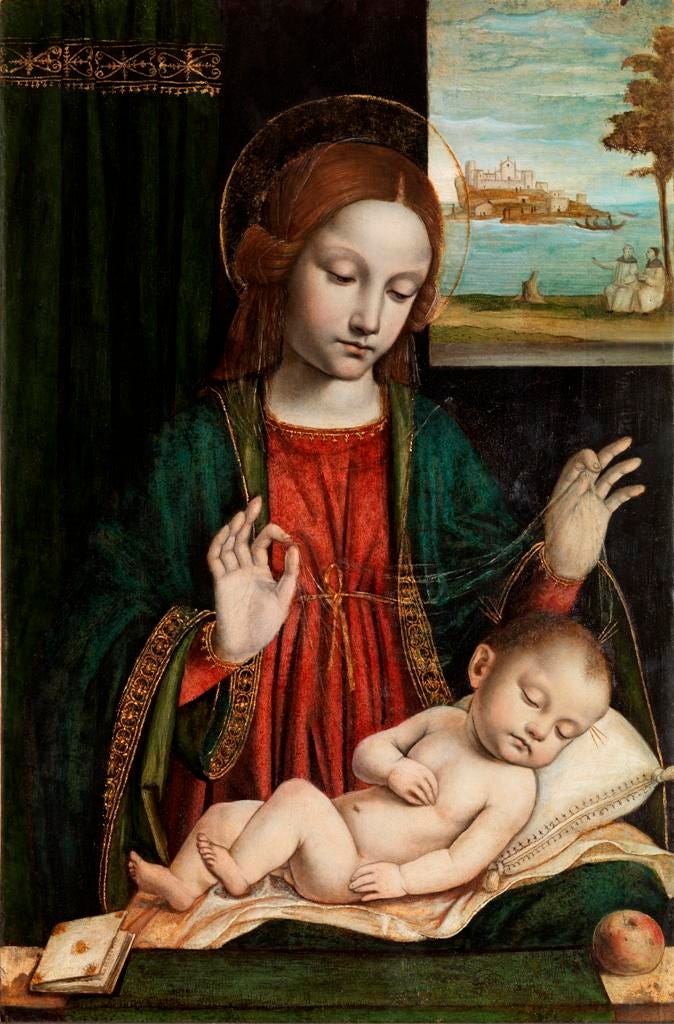
At the Museo Poldi Pezzoli, I came across what I thought was another anonymous depiction of Saint Barbara. In the paintings, the gender ambiguous and dainty figure bears a chalice of the transubstantiated host, as the Saint’s last wish before her death was to receive the host. There’s an edifice in the background, presumably the tower where her father imprisoned her. She has a translucent scarf, not dissimilar to Bergognone’s Madonna of the Veil, which alludes to the shroud that will come to cover Christ’s corpse at the crucifixion (note how the child conceals his own genitals in tandem). The woman is wrapped in it herself. On the left, the same woman is not in the building, but looking at it from below, as workmen seem to be building it. Why would Saint Barbara be supervising the construction of tower in which her father would imprison her? On the left, she seems to be preparing the chalice in some manner, but the scene is absent of any priest or cleric. I don’t see any churches, any crosses, any sign of martyrdom. This isn’t Saint Barbara, but rather Artemisia, the Queen of Caria who married her brother Mausoleos. His death rendered her grief-stricken and soon psychotic. Her lasting tribute to her brother was the construction of the Mausoleum of Helicarnassus, one of the Seven Wonders of the World. In the short term, she drank the ashes of her brother-husband in a concoction of wine and her own tears each and every day.
The Master of Griselda is deliciously screwed up, but perhaps no more screwed up than the gruesomeness of transubstantiation: that the Eucharist serves to communicants the literal bodily remains of a man who has only died, but willingly succumbed to your violent sexual fantasies to make it happen. Divining the artist's intent is futile. Still, the painting has a stunning effect when set alongside so many works of art that faun over the miracle of the sacrifice and the hope that immense tragedy might beckon us to higher callings. On the death of her brother, Artemisia doesn’t become more virtuous. She becomes crazier. But is the penitent Christian any more virtuous? When we build churches, do we not build monuments to the victim of our own cannibalism?
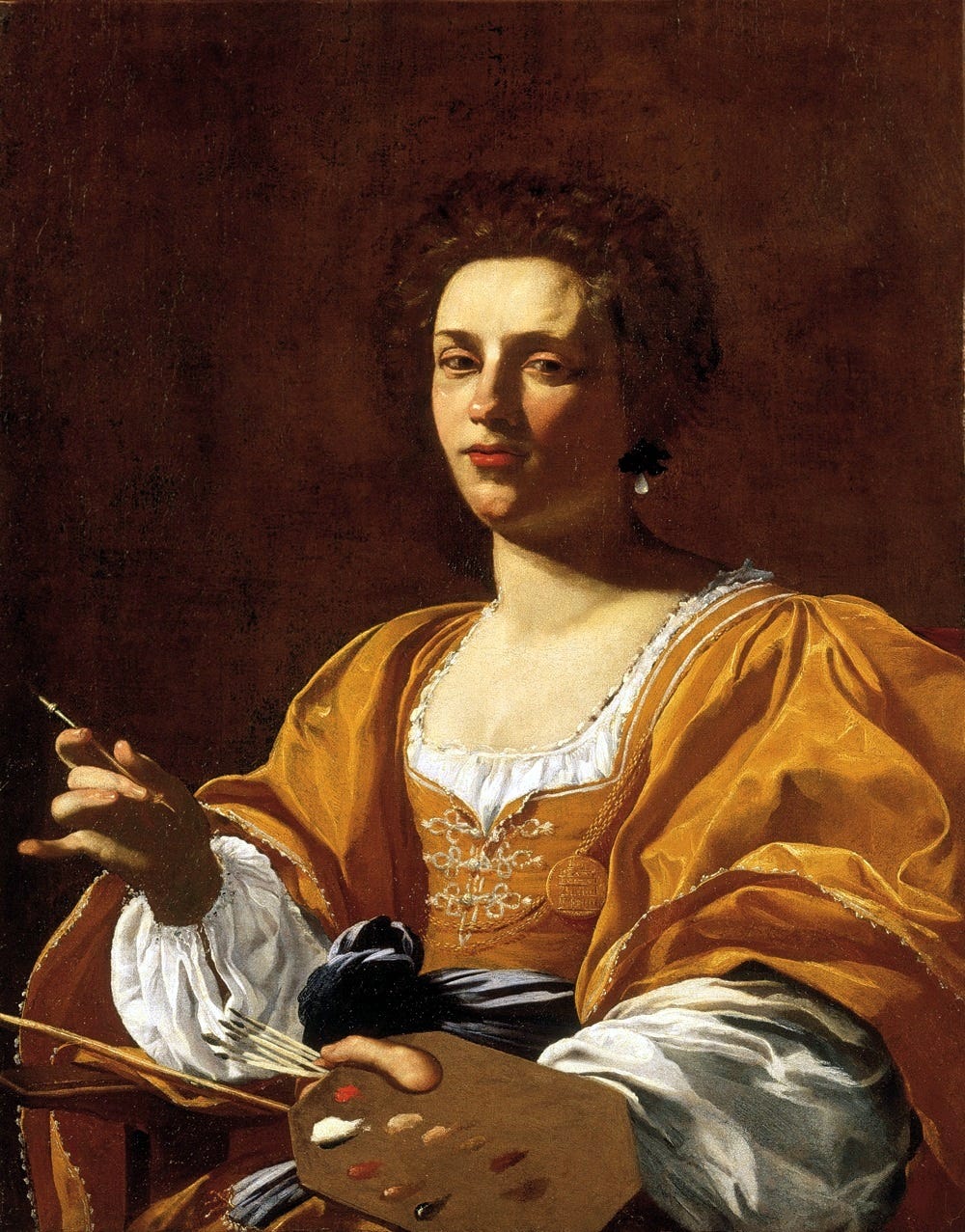
I arrived in Paris two weeks later, where my first stop was (as usual) the Musée Jacquemart-André, to see an exhibition of Artemisia Gentileschi. The dead giveaway as to her preoccupations or defiance is not so much her self-expression in the numerous depictions of cranial trauma and beheadings of men at the behest of strong women, but rather the more subtle clues in how others saw her and her work. Simon Vouet shows Artemisia at the ready, paint and brushes in hand, bearing a medallion of an edifice, which blends seamlessly into her dress. If you’re not looking for it, you might miss it, but there it is: the Mausoleum of Halicarnassus over her left breast - that is, her heart.
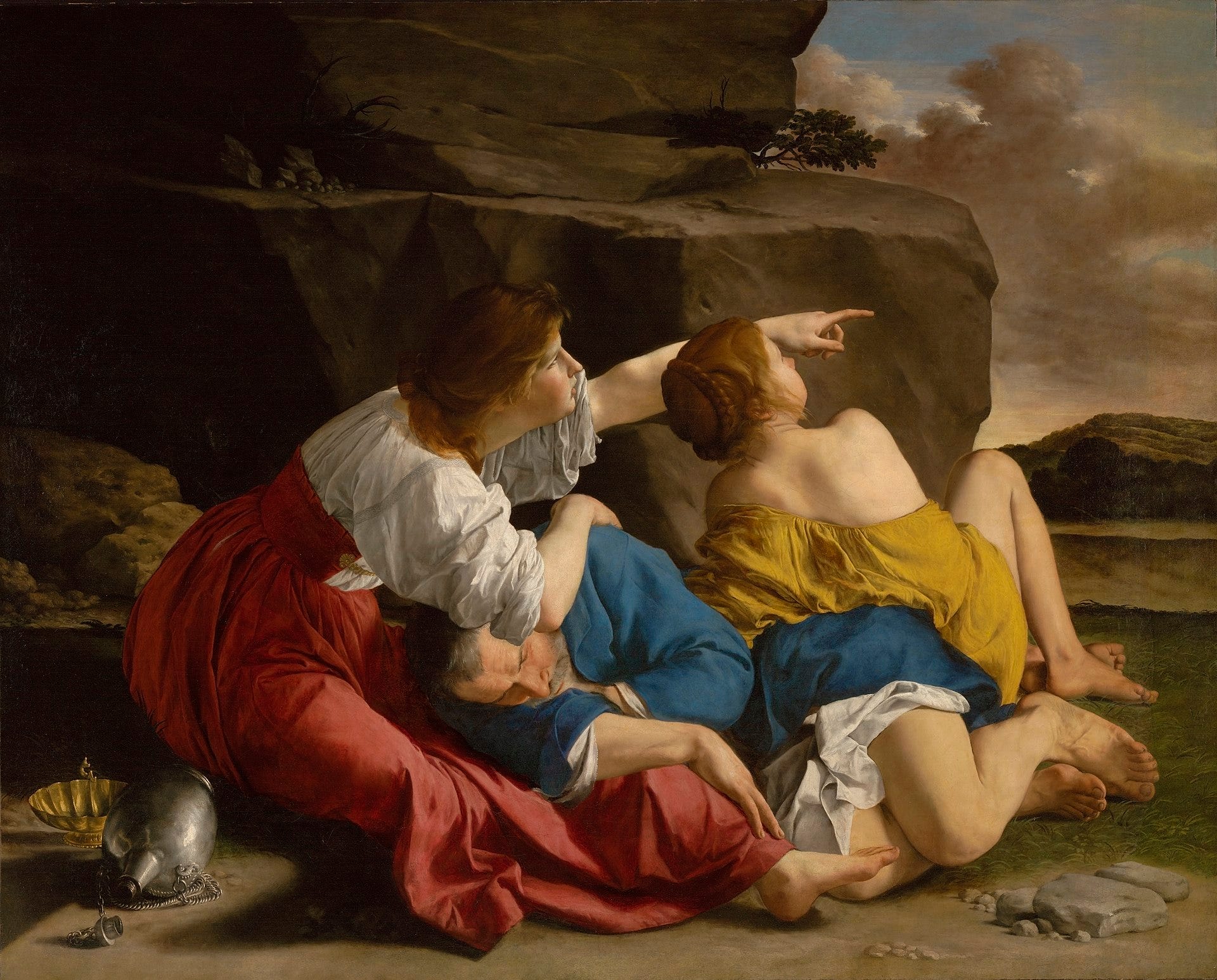
Artemisia Gentileschi’s fantasies of misandry and violent lust are set alongside the works of her father and brother (who are dually credited with helping to shape her technique), while her rapist, painter Agostino Tassi (whose work is absent in the exhibition), is credited with informing her content. Of course, I have no qualms with learning about Artemisia Gentileschi’s toils; they are rightfully discussed. What I struggle with is the extent to which her father gets off. Was she not raped in her father’s house? When her father promised Artemisia’s hand in marriage to Tassi, had he not been imprisoned prior for incest? And for arranging to murder his wife? And did not Orazio use Artemisia as a model in his depiction of Lot, who is victimized by his ravenous and incestuous daughters? (Or indeed, did not Artemisia depict herself in the same manner, some decades later?) Why are we obsessed with the single episode of Tassi’s, and not the longer arc of hell set in motion by an obsessive father, and possibly, a brother in tandem? Why is Artemisia Gentileschi uniquely the victim of rape, but not of incest?
I pass no judgment on the curatorial decision-making, but I’m curious as to how it is we’ve come to view Tassi as a villain (whose work is remarkably difficult to find online), while we skim over the crimes of others. We musicians have recordings innumerable of Don Carlo Gesualdo, who murdered and dismembered his wife and her lover, mutilated their respective genitals, and impaled their skulls, all before murdering his own infant child by way of violent torture. And all art lovers have Caravaggio, a known pimp who murdered a rival sex trafficker by stabbing him in the groin. But of course, these two have given us the “chromaticism” we supposedly crave - visual and auditory manifestations of normative violence.
We’re human, and so we pick and choose. I don’t think there is any really good answer as to “hows” and “whys.” But a few weeks in art museums have been an interesting reminder that rape, incest, inhumane violence and torture are in fact rather pedestrian and commonplace. It’s not that we ignore them; we just make them special and call attention to them when it suits us - that is, when we can imbue violence with redemption.
About the Mantegna Christ, note that a purely technical issue inheres in the painting, that is, the still recent discovery of the laws of foreshortening. Masaccio and Uccello were pioneers in using this technique. Mantegna has not entirely mastered in this painting and we're allowed to wonder why he showcased it so glaringly as he did here. Worth pondering.
Thank you for these beautifully crafted reflections. Insightful and challenging. I very much hope you carry on writing